Templar header

Templar header

Saturday, May 3, 2025

TEMPLAR LINEAGE OF GRAND MASTERS AND REGENT SOVEREIGN PROTECTORS

Templar Lineage of Grand Masters and Regent Sovereign Protectors

TEMPLAR LINEAGE
The Order of Templar was founded by the Crusader Princes, according to the Chronicle of Simon de St. Bertin, in the year of our Lord 1099.
The Order was consecrated between hands of the Patriarchs of Constantinople and Jerusalem in the year of our Lord 1118.
The Order was formalized with a monastic style rule at the Council of Troyes in the year of our Lord 1129.
The Order was granted church status immunities and privileges by the Western Pope, in the year of our Lord 1139.

GRAND MASTERS OF THE ORDER
1118–1136 Hugues de Payens
1136–1149 Robert de Craon
1149–1152 Everard des Barres
1152–1153 Bernard de Tremalai
1153–1156 Andrew de Montbard
1156–1169 Bertrand de Blanchefort
1169–1171 Philip de Naplous
1171–1179 Odon de St. Amand
1180–1184 Amaud de Toroge
1185–1189 Gerard de Ridefort
1191–1193 Robert de Sable
1194–1200 Gilbert Erail
1201–1209 Philippe de le Plessis
1210–1219 Guillaume de Chartres
1219–1232 Pierre de Montaigue
1232–1244 Armand de Perigord
1244–1247 Richard de Bures
1247–1250 Guillaume de Sonnac
1250–1256 Renaud de Vichiers
1256–1273 Thomas Berard
1273–1291 Guillaume de Beaujeau
1291–1293 Thibaud Gaudin
1294–1314 Jacques de Molay
1303–1344 Duke Otto of Brunswick, officially Grand Master of the German Templar at Imperial Capital of Supplingenburg-Brunswick, a Sovereign Templar Principality state in continuance.

SOVEREIGN REGENT PROTECTORS
Duke Magnus I (1344–1369)
Duke Magnus II (1369–1373)
Duke Frederick I (1373–1400)
Duke Henry the Mild (1400–1416)
Duke William the Victorious (1416–1482)
Duke Henry IV (1482–1514)
Duke Eric I (1514–1540)
Duke Eric II (1540–1584)
Duke Julius (1584–1589)
Duke Henry Julius (1589–1613)
Duke Frederick Ulrich (1613–1634)
Duke Augustus the Younger (1635–1666)
Duke Rudolph Augustus (1666–1704)
Duke Anthony Ulrich (1704–1714)
Duke Louis Rudolph (1714–1731)
Duke Ferdinand Albert II (1735–1746)
Duke Charles I (1735–1780)
Duke Charles II (1780–1873)
Duke de jure Ulric deCivry Guelph Brunswick cadet branch, heir-at-law (1873–1935)
Regent John MacGregor McNeil, the Templar Mining magnate of Colorado and Canada and of the Ducal family cadet branch (1935–1940)
Duke de jure George d'Guelph Brunswick cadet branch, successor house (1940–2012)
Duke de jure Stephen M.K. d'Guelph Wolfenbuttel-Brunswick (2013–Present)

Templar Continuity at Supplingenburg

The historical legacy of the Knights Templar in Brunswick was preserved beyond the suppression of the Order in France. At Supplingenburg, a key stronghold and Imperial capital, Duke Otto of Brunswick continued the traditions and leadership of the Templar Order. This location remained a recognized sovereign Templar Principality well after 1314, marking it as the central seat of Templar persistence within the German realm. Tempelhof Brunswick also continued, between the Knights hall, St Blaise Cathedral, and the ducal palace(Schloss Arkaden) at Brunswick. Notably in the 1321 Agreement and archival evidence it's demonstrated that many Templar holdings in the greater domains of Brunswick were never transferred to the Hospitallers, and remained under ducal protection and administration well into the 15th century and beyond.

Thursday, April 17, 2025

Brunswick Grand Commandery of the Knights Templar

Brunswick Grand Commandery of the Knights Templar

Foundational Charter

We, the undersigned, in full recognition of the enduring mission of the Order of the Temple, and in continuance of the noble traditions of the original founders of the Knights Templar of Jerusalem, do hereby proclaim the establishment of the Brunswick Grand Commandery of the Knights Templar.

This Commandery is established under the authority of the sovereign and dynastic House of Wolfenbüttel-Brunswick, whose lineage and regency have continued uninterrupted since the time of the Crusades and whose protectorship over the Templar legacy has been historically maintained.

We affirm:

  1. That this Grand Commandery serves as the international arm and heir of the original noble houses which bore the red cross and served the Kingdom of Jerusalem.

  2. That its founding is rooted in both spiritual and temporal succession, upheld through legitimate rights of sovereignty recognized under principles of international law.

  3. That our ecclesiastical protection is provided by canonical successors of both the Eastern and Western traditions, including the Metropolitanate of Gothia and the Orthodox Church of the Culdees.

  4. That our members, whether of noble birth or demonstrated merit, are bound by solemn obligation to defend the faith, protect the weak, and serve the cause of righteousness, charity, and Christian sovereignty.

We declare this Brunswick Grand Commandery open to alliances with other Commanderies, provided such alliances uphold the foundational traditions of fealty to Christ our King, adherence to canonical order, and acknowledgment of legitimate fons honorum in accordance with the laws of chivalry.

By this Charter, we also affirm the issuing of charters to other regional or national Commanderies under the spiritual and regnal authority of the House of Brunswick, with appropriate oversight maintained by the Grand Commandery.

Signed and sealed this day,

His Most Serene Highness Duke Stephen d’Este-Guelph Brunswick
Head of the House of Wolfenbüttel-Brunswick
Grand Master of the Brunswick Grand Commandery of the Knights Templar

[Seal or Arms Here]

Friday, March 8, 2024

Brunswick Royal Title (of Dr Stephen MK Brunswick), sovereignty kept alive per all laws of prescription and international law.

 Brunswick Royal Title (of Dr Stephen MK Brunswick), 

sovereignty kept alive per all laws of prescription and international law.

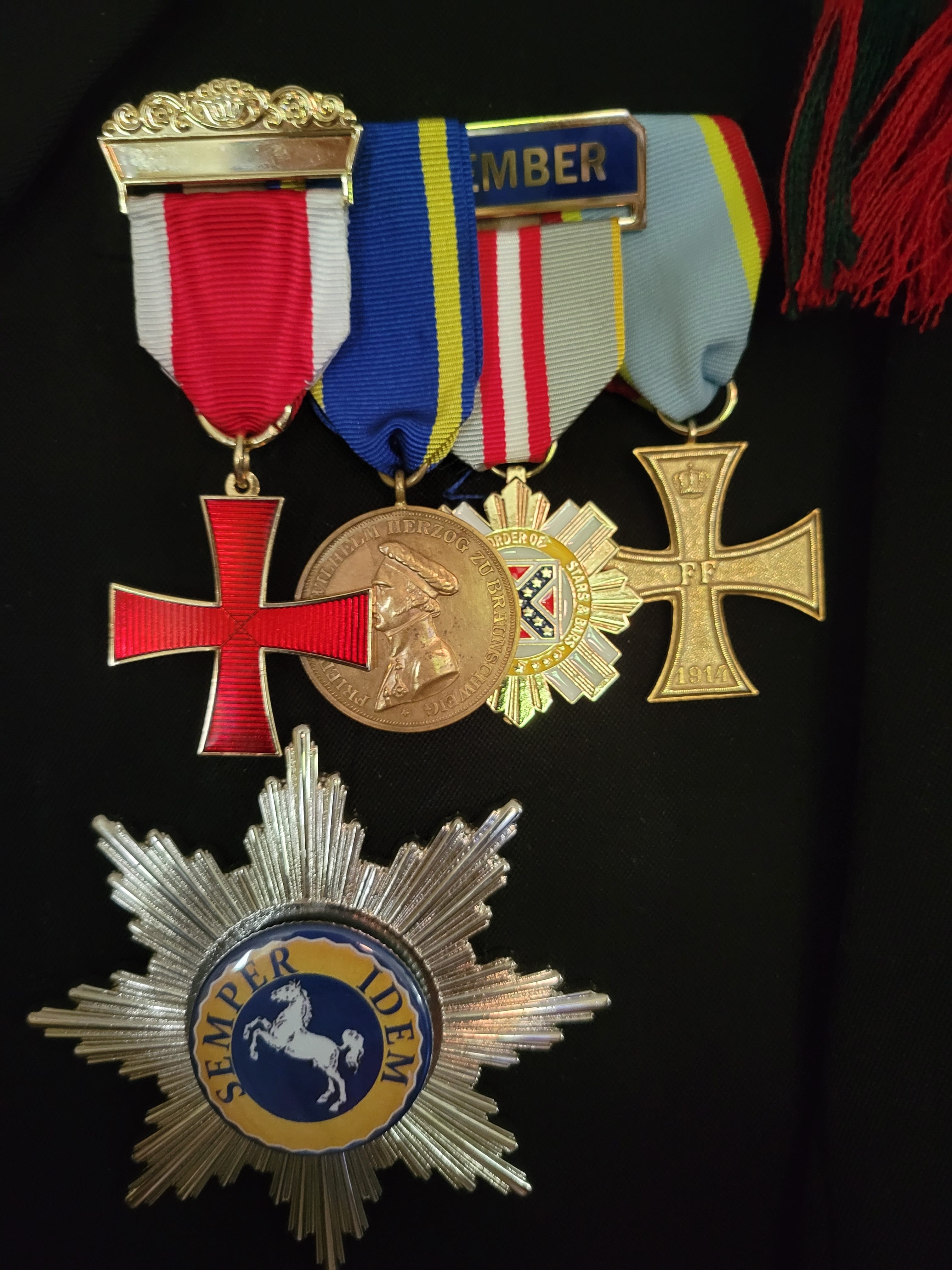
(Below is a zoom in on 1 part of the military coat of HMSH Dr Brunswick. A few of the military heritage medals of His house).

HERALDIC REVIEW: The de jure Brunswick title, as passed down via the Brunswick Foreign Legion, the Brunswick Parliament, the Republic of France Treaty, Switzerland, the USA, the 1935 Geneva custodianship verdicts, the Germanic Confederation, the 1827 edict reviving the original stem duchy rights, and other Treaty laws transacted with the same modern governments, culminated in the Wolfenbuttel cadet branch embedded as officers of the Mecklenburg Ducal and Imperial Guard, the multi-generational Calvary/Husar Brunswick family of Mecklenburg ultimately (during the treaty guarantees of the estate entities and domains within the title) Who immigrated to America in 1867 for the broader enjoyment of Their inheritance in this modern age of communist usurpist and violent marxist theft from the true owners of all global property. Thus under the Treaty law of the land, The family has successfully maintained Their personal inheritance rights, and as a result maintains the rights of The Chiefship of five Imperial Domains by the primogeniture / firstborn blood right of The established, cumulative, long ceded States rights as valid “next-of-kin”, as contracted the Capitals as said property belong to de jure branches of Brunswick Heirs. The blood-right Heirship of said several foreign Sovereign capitals of said territories, were recognized to Brunswick as joint-Heirs in event such domains failed to produce their own locally representative Heirs via de jure processes of rightful estate Owners, or other claims to original Sovereign estates via Parliaments or Regents of said Capital entities of States. As thusly remains maintained alive in international law designated as established property per the norms of said within The perpetual demonstrated Coat of Arms of Imperial French, Piast Russian, and German Pretention, as well as Brunswick alloid Capital elements. The assumed aspects of blood-rights in international law retain as a valid claim as evident in The continued usage of The Imperial House Names, “Este-Guelph and Wolfenbutel-Brunswick-Oels”. This continues the Sovereign rights to said properties of The Name, titles and honors, as per the norms of international law for used for all non-reigning and non-territorial Nobility as validly used and recognized by the wider community of modern Sovereign nation-states. The rights to be restored upon valid suffrage movements not surrendered. Therefore The Title cannot be extinguished by other prescriptions, so long as no Chief or head of the house has renounced it with valid arbitrary, or authority of said exclusive estate entities. This continuance is validly accomplished while simultaneously not interfering in usurper governments claims to said registered or unregistered territories. This continues as long as it is known and argued on an annual or at least Centennial basis. So a minimized version of property rights lives on per the basics of international law, and so therefore a hope remains for eventual true property rights restoration. The Brunswick Representation provides a bi-millennial strong basis for those who wishing to withstand the storms of the present Marxist robbery against all who desire the protections only found in exercising true legitimate Sovereignty, and therefore retaining all that has perpetually been theirs via the basic rights enumerated therein, and the continued struggles of their forefathers pursuant thereto.

Tuesday, February 6, 2024

The Brunswick Commandery Fons Honorum

 The article is found at: https://st-andrewsocc.org/2022/02/legitimate-templar-fons-honorum-continuing-in-brunswick/

intro: The House of Brunswick descends from the original Nobility (Angevin) who had set up and founded the Knights Templar. Not only this, but Brunswick has also maintained it’s status as the rightful head of House for the Nobility who founded the Templar. This was confirmed in numerous early charters and invoked by Brunswick heads of states with full recognition and treaties with present ruling governments, as continuing within the norms of international law today. Wolfenbuttel-Brunswick being the senior princely house of Germany (as co-treaties of numerous present reigning governments confirm this absolute right) did not in any way abdicate or sign away any of the rights of absolute dynastic rule to any new constitutions or any new entities that would seek to deprive the same. The unlawful occupations, usurpations, and de facto governments claiming any portion of our lands have been continuously protested against by the house of Wolfenbuttel-Brunswick without interruption.

On Joining the Brunswick Commandery Knights Templar

 Many want to join our legitimist order of the Templar, successors of the founding house of Angevin etc. However, in keeping the tradition, this may be a lengthy process of applying. The persistence in directly applying to be a Templar, asking multiple times and demonstrating worthiness will eventually get one admitted to our Order.

A good first step would be applying to our affiliate church (Orthodox Church of the Culdees). The Celtic Culdees were the original Chaplains of the Templar, and are key in our restorative order.

Our non-conformist Celtic institutes carried on the traditions and in Scotland also the Royal House protected us from the English seizing the Templar estates.

Not only of the Culdees houses in Scotland and Ireland, but also in Brunswick Germany and in England did the family of our Primace take and protect the Templar estates to continue without interruption.

In our Templar Categories you can learn more about the Templar Jurisdictions of England and Brunswick (and on blogger the Templar of Gothia page).

However if you’re ready to be involved in agreement with the church, start the process by subscribing here.

This is for those who want to seriously be involved in humanitarian projects that truly effect the protection of God’s church, and protects our pilgrims at our holy sites etc.

Sovereign Knights Eligible to Apply to Original Templar Orders

Published at: https://celticorthodoxy.com/2022/07/actual-sovereign-knighthood-required-for-eligibility-to-apply-to-the-knights-templar/

A text to question existing social clubs calling themselves Templar:

(Note: We want to empower and unite all Templar orders who presently do not have true sovereign protection. You may enjoy these benefits under our Ducal House of Wolfenbuttel-Brunswick(and global estates), who shall sub-infeudate tenancies (or Lieutenants) who may sub-lease theirs out to multiple additional true pre-requisite estates of Knight service. Normally a true Knight will have several sub-tenants, and each subtenant is a knight, who has their own support networks (always 2-6 supporters).
Are you of a legitimist order of Templar? If not holding actual knighthood under a sovereign, (or not applying with a certified and registered pedigree proven to be of Noble lines, with at least 200 years of marriage licenses etc), then you can work with our expert genealogists on getting the registration going. We may also find in the process you’re entitled to lands (which are more easily claimable if it has gone into disrepair), and in some cases this may also require DNA tests.
This true Knighthood has been the basic requirements for thousands of years by any true sovereign Kingdom. This is a matter of public law, international law, treaty law, constitutional law, dynastic/family law, and inheritance law as recognized by the Governments and Ecclesiastical institutions as being the only valid definition of Knightly orders. The ones that truly exist are plentiful and the fake ones can be sued or held criminally liable by any of the governments for infringing on their matters of state. Sometimes there are agreements for the fake (or social club only type) to take on names sounding similar to the actual Knightly orders, and their protections may range from corporate / company protections, which include merchant related commercial copyright and trademark protections, for local governments to understand how they pay taxes on such social club entities. However, those names of institutions may have nothing related to the current Monarchs and their actual true successive orders which have a true fons honorum in international law.
There are several Kingdoms and Dukedoms who maintain protections for Templar institutions (which today may not today use the name Templar exactly but are all of it in substance). Anything outside of these parameters is something new and should use different names other than Knight or Templar, if they will be Christian and honest. All Templar are first under their local sovereigns as Knight families (with enough lands to support a knight, which was a lot, with enough serants etc, as required to supply / maintain / fit 1 knight etc). This is the way. We’re here to support the true, or if wishing for investigation, we will help you all. You may wish to be a supporter to a knight, or gain adoption as well.
One thing few know is that only actual existing Sovereign Lawful Knights (holding land tenancy in fee of military service of their lord) could become Templar. Exceptions could be made if your father had right to become a knight (under his sovereign or if that government was in exile but had lawful right in international law). Also you couldn’t be admitted if you were born out of wedlock. There were no outlaws admitted, none with debts or conflicting vows or what would bring liability to the order. All bastard sons of the Kings/Princes etc were especially banned because that would create even more liabilities. So these were true knights with Royal protections, as they combined their secular knighthood with Sacred. I think it was good that their activists for Christ were so irreproachable. As Knights of real Sovereignty before they had joined, they had never in any way renounced their Sovereign / National Knighthoods. So they carried their weight above the bar.
It wasn’t till a generation later that the Templar were flourishing that the Western Pope of Rome decided to endorse the order.
Also this was the battle flag of the Templar. Simply the standard of Black & White. I like this idea as truth is black & white.

As published by the House of Brunswick. From
Statutenbuch des Ordens der Tempelherren

Basically you must be already at the rank of knight by your local government, or father was at least with the right to be a knight. This can be also de jure rights to knighthoods when an existing Sovereign Government is still alive as per international law but maintained in exile at least by usage of title, and that the head of house has not renounced claim for any period, and if dormant the usage of the name and title of the monarch must be continuous, without gaps of more than 50-100 years for valid sovereignty in international law / laws of prescription. This title would have to not have been renounced by law and must have a continuous claim / protest to maintain their sovereign government. Proof of this continued protest is often satisfied by by using the coat of arms without interruption etc.


Celtic Scottish Knights Templar


Celtic establishments of our Templar Order.


For sincere inquirers, please Apply for membership.

Topics:

+ Scottish Templar

+ Scottish land charters and titles prove the continuance.

+ Henry Sinclair

+ The Charter of Transmission

+ Founded a generation before Roman endorsement

+ East and West Rites used equally

+ Scottish Catholic represented a purer Protestantism

Scottish Templar
King Robert the Bruce, continued the practice of his predecessors, to protect and expand the Templar in Scotland. When the charges and attacks on the order began, there are numerous records of his acts of giving them a safe refuge and employment as deserving of Knights. He recognized their charters and the Templar and they were proclaimed not guilty the charges.

When the order came under full attack by Rome and France, it’s said that the remaining Templar ships sailed for Great Britain in order to reach the safe ports of Ireland. From there, they made contact with the separatist Scottish leader, Robert the Bruce, who was at war with England and the Anglophile clans. Robert already ruled a considerable part of Scotland where neither the papal bulls nor the authority of the Vatican, which had recently excommunicated him for his rebellion, was valid. He generously received the Templars, who for their part offered him their collaboration in the campaign against England and its local allies.
The chronicles tell us that on June 24, 1314, Robert went into battle with six thousand men against an army of twenty thousand English soldiers in the decisive Battle of Bannockburn. The spirit and bravery of the rebels were not sufficient to overcome the difference in numbers between the two forces, and the luck of the battle was inclining toward the English. But then, a formation of cavalry bearing its own flags and standards appeared from behind the Scottish rear guard and entered into combat. When the English recognized the Templar emblems and saw the eight-pointed crimson cross on the knights’ chests, they were terrified.
They scattered, yielding the victory to Robert the Bruce. With the defeat of the English, Scotland became an independent kingdom without any obligation to the papacy. The Order of the Temple easily installed itself and acquired a number of properties and fiefdoms, especially in the region extending north from Glasgow. The Templars prospered under the protection of the clan of the Saint Clair, or Sinclair, lords of Roslin, a high lineage of Danish origin related by marriage to William the Conqueror and the Stewards (or Stuarts). This last family, to which Robert the Bruce’s wife belonged, became rulers of Scotland in 1371 and reigned over England from 1603 to 1714. This family being the line of Anjou, the founding house of the Knights Templar.

Scottish land charters and titles prove the continuance.
“The Knights Templar in Scotland” by Dr Coutts, covered the proof the Templar charters continued to be recognized by Robert the Bruce, and supported the Templar as an order under a slightly different spelled name.
On page 135 he covered the facts that joining the order had always been rather difficult. One could not join the order if they could not prove themselves to be of at least 4 generations of Noble birth (Knights) on both sides of the family.

He wrote:

“In 1153 the Military Order of the Knights Templars was introduced into Scotland by King David I, who gave them a grant of the manor and chapel of Balantrodoch. This is a Celtic name — Baile nan Trodach — ” Stead of the warriors.” But the name appears in many forms, and one of them is Balantroch. Is it possible that a gravel bed left by a glacier — part of which still remains near the village of Temple — may have given the original name, Baile nan Trachaid (Traghad), ” Stead of the sea- 1 The Chronicle of St. Denis gives the year as 1313. shore,” which, afterwards, when the Templars possessed the manor, became “ Stead of the warriors ” ? At the end of the I2th century and during the 13th century, as in other countries, large endowments were lavished on the Order in Scotland d By the gifts of the Scottish kings alone the Templars gained possessions in many parts of the kingdom from Galloway to Aberdeenshire. Malcolm IV, King of Scotland (1141-1165), donated to the brothers of the Hospital of Jerusalem, and to te soldiers of the Temple of Solomon, a complete homestead in every burgh through- out the Kingdom. 2 William the Lion, who reigned from 1165 to 1214, gifted to the Knights the Barony of Maryculter, which extended to 8000 acres. Here the Knights had a Preceptory, and in 1286 they were allowed to build a church for their tenants. After the Reformation this became the Parish Church, and was in use till nearly the end of the 18th century. Alexander I, II, III, Robert I, II, James II, HI, IV confirmed and increased the gifts to the Temple from the Royal Exchequer. Besides those benefactions, there were many others who bestowed gifts of lands upon the Order. These were known as Templar Lands, ‘ ‘ quasi terrae concessae Militibus Templi Solomonis.” The earliest Scottish Charter relating to the Temple bears the date 1160 (during the reign of Malcolm), seven years after the institution of the Order in Scotland. The names of Richard of the Hospital of Jerusalem, and Robert, brother of the Temple, are on the record. The loss of the Cartularies of the Preceptories has left us in great ignorance regarding the history of the Order in Scotland. And that is also true of the Hospital. Not till the middle of the 15th century, when Sir Henry Livingston was Preceptor of the Hospital, do we have records giving us any details. Because of this, there is lacking definite information about the Preceptories, the number of the Knights, and the part they played in the struggle for Scottish Independence.”

Henry Sinclair
The Templars had fought at Bannockburn under the command of Henry Sinclair, whom Bruce made Prince of Rosslyn and the Orkney Islands. The west entrance to Rosslyn Chapel, surmounted by a magnificent rose window with an “engrailed” cross.
Clearly this well known Templar family were protected in several ways to ensure the order continued under somewhat new styles. King Robert the Bruce created the Royal Sovereign Order of Scotland. It’s said that the King also appointed William Sinclair as the Grand Master of the Crafts and Guilds of Scotland. This became a hereditary position with the Sinclairs until another William Sinclair resigned the hereditary post of Grand Master for himself and his heirs. He was then immediately elected as the first Grand Master in the Scottish Grand Lodge of Speculative Masons in 1736. At this time the Freemasonry ranks and titles were under full protection of the Crown, along with the genealogical recognitions of the Noble Knight family’s inheritance.
By the 1800s tens of thousands of men of rank in England, Scotland, Ireland and Wales had openly demonstrated themselves as Templar under Royal protections. These had boldly avowed themselves as the modern successors of Templar. As with most feudal knightly based land titles, this was coupled with demonstrating succession from the original Noble Templar families. Any one of the sister orders of the Templar, this requires legal proof of succession from the original Knights.


The Charter of Transmission
There is a greatly protected document demonstrating the continued transmission of the Templar order to today. It was republished under the title “Sketch of the History of the Knights Templars” with approval of the Crown in 1840, when Prince August Fredrick was the Templar’s Grand Prior of England. Within the book it included several other charters such as from King James the IV of Scotland re-confirming the inheritance of the Templars in the sixteenth century. This publication constituted force of law on behalf of the Templars. This is upheld in the British Crown Office Act of 1877, Section 3.3. Since prior approval was made, it thus created a binding legal fact of public law, by force of law.
Queen Victoria’s son, King Edward VII also reconfirmed these (and many other charters) when he was Grand Master of the English Templars.
In Scotland, as in Brunswick, there was no enforcement of the demands to transfer the Templar estates to the Hospitallers. Normally new properties are immediately incorporated into an existing inventory. This happened all over Germany and England but it did not happen with the Templar estates in Brunswick, nor in Scotland. In Scotland King James IV acknowledged this.
He confirmed all former grants of land made to “Sancto Hospitali de Jerusalem, et fratribus ejusdem militia Templi Salomis”.
This reference to the Templars is said to prove that the Templar Order maintaned an existence that was equal to, or united with the Hopsitallers. The name Templar was never removed from the land titles in Scotland, as it was in other countries around the world.

Founded a generation before Roman endorsement
The Templar were not formed by any of the Roman church. The Templar were formed into a distinct order a full generation before any Roman papal endorsements/benefits etc. It’s recorded history that about 30 years before that papal endorsement, that they were formed as a holy order of Knights (French/Anjou/Angevin Royal Knights) between the hands of the Patriarchs of Constantinople and Jerusalem, while in service of the East Orthodox Emperor which had most strongly divided itself from Rome.
Founded by Pre-Schism Princes, Knights and Clergy
The founders of the original Templar grew in a church before the great Schism even occurred. It was one church in their eyes. The primary Chaplains of the Templar (Benedictines) still identify themselves as Orthodox, and as a pre-schism order of monks.

East and West Rites used equally
As primarily serving in the East, the primary place the Templar worshipped was in the East Orthodox churches. Templar always had worshipped in any nearby Christian church where the same one united church held the services. Many of those churches in the West were founded Orthodox, and always were Orthodox. The priests and bishops of the West had often protested against Rome, and even many Western churches officiating 2 or 3 generations after the Templar were formed, only followed the Eastern Orthodox rites.
The Templar continued to recognize the Eastern popes well after the Great Schism. We know there were two popes recognized just of the Roman rite alone, and many more popes of the other Western rites. That is whether using the name pope, or equivalent terminology for centuries, calling the pope of Rome their fellow “brother” or equal “bishop”. In the East they use the word pope more often for their elders and patriarchs. So many people are stuck in the mentality that only the Roman pope (not the dozen other non-Roman popes of Christendom) represented the Christian orthodoxy of the Templar. However the facts show the opposite.

Scottish Catholic represented a purer Protestantism
Till the time of St Margaret (after the Templar order was formed, and long after the great schism) the Scottish church still primarily followed the Eastern Orthodox (Johanite Anatolian and French/Gaulish) and Celtic church Calendar and customs. Some of the biggest of these differences with the Roman church were the Saturday Sabbath, Biblical dietary laws, and the dating of Easter (or the Sacred Calendar beginning date for each year). The Patriarch of Constantinople had highlighted the primary cause for the great schism as being the observance of the Biblical Saturday Sabbath.

(You may wish to read more about the Celtic Culdee church, and our Benedictine Chaplains of the Templar at https://St-Andrewsocc.org and several books on Celtic heritage at www.Celtic.press. Several of the thousands of books on British Israelism, the throne of King David, etc you can read freely online.)

Saturday, August 19, 2023

British Israelism Teaching, the Anglo Saxon Traditional Message of the C...

The church of the East and West has long celebrated the Celto Saxon and Kindred Peoples as being representative of the True Israel of God. Although this topic has been taught by millions we have lately found it covered up. That is very intolerant and non-inclusive to ban / censor and cover up thousands of books on the topic written by the mainstream leadership of the Orthodox English church! If you do a search in youtube for the topic of British Israelism it’s buried under dozens of videos done by non-genetic Israelites who hate the message of the historic British Israel church.

So help us get exposure by liking, subscribing and sharing to our video, which aims to break through this block on the “British Israelism” topic on youtube: youtube.com/watch?v=y8vjpO6BOtk (more on the topic on our site: British Israelism).

Herein you may find an unbiased disclosure of the traditional British Israel teaching taught by millions of British adherents of the Traditional Orthodox Anglican Religion. Thousands of books available on the topic:

Enjoy it!

Here is a study of the Celtic church 

Sunday, December 19, 2021

Our Gothian Templar Land Claim Marker, 130 years before Columbus, Claimed America

 As the word of Yahweh says "remove not the ancient landmark"


A comprehensive and speculative analysis of the Kensington stone

Our Gothian Templar "Land Claim Marker" for America 130 years before Columbus. This land claim that was staked has not expired but has been reiterated, expanded, ratified and later brought into our "perpetual" Godly institutions known as our 1639-1800s state constitutions and articles of Confederation (preceding and post dating the English dominance) which state that our perpetual Confederation is covenanted together with "one and the same aim",  "the advancement of the kingdom of Jesus Christ and maintaining the purity of the gospel" in the period,
as these Christian covenants climaxed in defining the only true (and perpetual) union operating inside of America, as is widely confirmed for 99% of the time our our Gothic Christian(Caucasian / Caucasus-Asian) dominance of these prophesied farthest Western promised lands. **Note the legal term "perpetual" meaning long pre-dating and continuing throughout the ages**

Goths' Latin Psalter Found at Mt Sinai, dating to time of First Crusade under Raymond of Gothia

 Another important artifact for the Collection, the Visigothic style Latin Psalter kept at Mt Sinai since the 9th Century. (note although we see the 9th century mentioned, we have proof the Visigothic Prince of Gothia, Raymond IV, led the largest armies of the first Crusade, and no-doubt carried such Psalters. As we have demonstrated in previous articles, it is more based in fact that he advised the formation of the Templar order. ) https://www.persee.fr/doc/scrip_0036-9772_1955_num_9_2_2620

Saturday, April 17, 2021

More and more Scholars Agree the Glastonbury St Joseph history is valid, and not just a "grail legend"

More and more scholars are beginning to agree that the church history about Joseph of Arimathea founding the church at Glastonbury, was correct. It was not just some "grail legend. Some articles that may help in this area are found below, as from the Priory of Salem, Institute of History:

The Jerusalem Church Moved To Britain, and the Apostolic See of Glastonbury, later called the “Second Rome”. Many 1st-2nd Century British Saints attest to this, see attached PDF of Saints

Numerous Ancient Manuscripts Confirming St. Joseph (of the Sanhedrin) Founded the British Hebrew Priesthood at Glastonbury in 36AD – St. Andrew's and St. Joseph's O.C.C.. Home of Watchman News, the Priory of Salem and TCAWW (orthodoxchurch.nl)


Numerous University Professors are interested in this topic of the true Celtic church and the Anglo Saxon Israel message of Christendom. So many have realized the truth is important, however the information has been very hard to find. 


 https://milkyway.cs.rpi.edu/milkyway/show_user.php?userid=1380128 

https://setiathome.berkeley.edu/show_user.php?userid=10935707

https://gitlab.rc.uab.edu/GaryBalderas


Saturday, May 16, 2020

Orthodox Benedictine Order served the First Templar, the Culdee Chaplains to the Templar

Another major reason to join our Orthodox order of Templar. Our first Clerics were Western Orthodox Benedictine Culdees. Yes at the court of the Frankish Kings which spearheaded the First Crusades were the Celtic church order known as the Culdees in several jurisdictions or as Benedictines in others.

At a time so near to the great schism, it can be easily shown that the founding knights of Templar were Western Orthodox, still in full communion with the Eastern church. Benedictines were a pan-Orthodox order from well before the schism, and continued. The jurisdiction in France known as Gothia(Visigothia/Langudoc continued as an (Western)Orthodox realm and people.
Most have just browsed over one of the greatest Templar clerical founders of the West, known as "Robert the Monk", Abbot of the Benedictine Monestary of Reims (Reims being the Lyons Gallic-Celtic French institution aligned in a long tradition of coordinating with the Celtic church (or Culdees). The Bishops of this jurisdiction held a co-apostolic succession from the Holy Apostle St John, a jurisdiction of Celts that was so well known to be an order not subject to Rome, and continued in the established traditions in the examples of the earlier Bishops, Polycrates and Polycarp. These early Bishops were all "excommunicated" from Rome for their primary theology held by the Culdees, like the dating of Easter, usage of the Hebrew Passover etc). (So it was clear not only as being in Pre-Schism order of Benedictines, of which were primarily consisting of Culdees of the time, but in the traditions of his home Monestary, they were indeed in line with the Eastern Orthodox. Numerous disputes came out of Lyons against the popes as well, for example the Waldensians, and later the larger Reformative wars. Many of our Celtic Culdees of France and Germany, not only Ireland and Great Britain, were Benedictine. Robert the Monk is recorded as being one of the most important Western Orthodox Clerics assisting at Jerusalem together with the founding Knights who took the oath together under the hands of the Patriarch of Jerusalem and the Patriarch of Constantinople. It is widely known and recorded these Orthodox Patriarchs founded the Knights Templar, totally outside of the Western Papal structure of Rome.

The Orthodox Templar order was founded by the Angevin Nobility between the hands of the Patriarchs of Jerusalem and Constantinople. For the first generations of the Templar there was no collaboration or endorsement from the pope of Rome. The order itself was formed very near to the time of the great schism at Jerusalem. The Clerical support was mostly within the pre-Schism Orthodox institutions (like the pre-schism Orthodox Order of St Benedict and their Culdee Chaplains) that continued it's full relations with the Eastern church. These Eastern and Western Orthodox Clerics worked with the Angevin Knights and Royals. The Patriarch of Jerusalem and the Patriarch of Constantinople together co-consecrated the start of the Knights Templar. They launched the Templar as an Orthodox institution decades before the Roman Latin pope became involved or endorsed the Templar as tax free within Western papal ecclesiastical jurisdictions. However, as time went on, the Templar would worship in any Christian Orthodox institution wherever they were serving. It amounted to about half Western Orthodox and half Eastern Orthodox institutions where they would worship. Even in the West several ecclesiastical jurisdictions never fully submitted to the pope, and whenever they did, there was more power in the local secular government to appoint bishops, rather than the foreign popes. Brunswick itself kept their Apostolic claim primarily to Saint Andrew as do most Orthodox, rather than Rome who makes claim to Saint Peter. The most prominent and tallest buildings in Brunswick, and most picturesque part of the city was dominated by the views of Saint Andrew's Cathedral.

The first several Templar Grand Commanders and supportive Princes were all solely of the French Angevin House of who also reigned over England and Jerusalem. As heads of the Crusader states, the Angevin House were the first 11 Kings of Jerusalem (or 13 indirectly). All were of the House of Angevin. The Angevin Empire lawfully set to be inherited by sons of the Brunswick line of the original Duchy of German Saxony.

However this Angevin Empire ownership portion of the Brunswick inheritance was unlawfully kept from the house by de facto usurpation and occupations. These have been protested by Brunswick and are in present protest and inheritance claim documents, as kept in full effect during the last two centuries. These have been kept alive via four international treaties by present reigning governments, as well as the unanimous Dynastic and Public law regarded therein. 

So not only the Noble founders of the Templar were most likely Orthodox, but also the Clerics themselves, and lower Knights and members were most likely all Orthodox. Nearly all the Knights under the command of the Prince of Gothia (Raymond IV), of which all of the peoples of his realm of ancient Visigothia (now a region called Langudoc) were long called "Orthodox". Although clearly the Patriarchs of Jerusalem and Constantinople had plenty of priests available at their local churches the Templar served, also there were supportive priests attending from the Benedictine Abbot of Reims, all "Orthodox". Therefore the original (or true Templar) may arguably be moreso considered Western Orthodox than Roman Catholic. For sure they are not a papal order itself, although were later endorsed by them, and by force of arms nearly entirely destroyed by them. There has recently been some recent news of reconciliation however. Finally after 700 years the Vatican has admitted the Templar were innocent of their crimes. This does not automatically place Templar into any unnatural alliance with Rome.

In 2013 several Western Rite Orthodox Benedictines and Eastern Rite Goths gathered together to anoint Stephen and consecrated our order restoration. His rank in Brunswick was also recognized as being an Imperial Elector for Gothian descended state territories and peoples (of which many of their church institutions were founded by his church, where he is head of the Culdees). This is the firm re-establishment in the true Original Orthodox Templar. The Brunswick House inheritance in Angevin is one of several points, including the Dynastic branches of the Goths princely houses as other additional rights as successors of the Templar founders. These rights have been exerted and re-exerted throughout the whole period of the overal Templar dormancy and stoppage of the Crusader Kingdom. As we have a vision for restoring the Crusader and Templar states in Jerusalem, this is why we will succeed. God wrote it in His word that our city will be there and thriving once again before Christ returns. This is why all sincere Christians should join our rank to protect our Christian Culture, and our holy sites throughout the world.

https://en.wikipedia.org/wiki/Historia_Hierosolymitana_(Robert_the_Monk)

Write to marshalofsalem@yahoo.com for more information about joining the Templar of Gothia.

Read more:

Ostrogoth and Visigoth United Royal Successor House, Brunswick-Wolfenbuettel, alloidial heirs of the Amali and Balti Dynasties

Successor of the Imperial and Royal Houses of Gothia TABLE OF CONTENTS SUCCESSORS OF THE BILLUNGS, AS THE DUKES AND EMPERORS OF SAXONY GERMANY(ROYAL HOUSE OF THE OSTROGOTHS) TITLE OF PRINCE OF GUTINGI (GOTTINGEN) BECAME A HOUSE TITLE OF THE HOUSE OF ESTE-GUELPH BRUNSWICK DESCENDANT OF THE ROYALTY OF GOTHIA IN THE TOULOUSE

Join the Imperial Goths

Name

Email *

Message *